

Reviewed · KIBERA COMMUNITY TOURS
Tembea Kibera
Kibera asks you to look closer. This private Nairobi tour is interesting because it brings you into daily life through local conversation, food preparation, street art, and community projects rather than a quick drive past. I like the small private format and the chance to meet people through a guide connected to Kibera. I also like that the visit includes a practical food lesson, not just sightseeing. The main consideration is that the setting can feel confronting, so you need to approach it with respect and an open mind.
The tour lasts about three to four hours and costs $40.90 per person. Pickup and drop-off are offered from hotels and commercial addresses along Ngong Road. One account describes traveling by matatu with guide Lucas, or Luca, who explained Nairobi’s public transport and matatu culture along the way. That may not be the standard arrangement for every booking, so ask before you go.
In This Review
- Key points to know before you book
- Why Tembea Kibera feels different from a standard Nairobi tour
- Meeting Kibera through a guide with local ties
- From Ngong Road to Kibera by local transport
- Walking through homes, streets, and community projects
- Learning to prepare and eat Kenyan food
- The emotional side of a Kibera visit
- Is $40.90 a fair price?
- Who should choose this private Kibera experience?
- Booking, weather, and cancellation details
- Should you book Tembea Kibera?
- FAQ
- How long does the Tembea Kibera tour last?
- How much does the experience cost?
- Is hotel pickup available?
- Is this a private tour?
- Does the tour include local food?
- Can I cancel for a full refund?
- What happens if bad weather cancels the tour?
- Is the tour available every day?
Key points to know before you book

- A private walk through Kibera: Only you and your companions take part, allowing more room for questions and conversation.
- Local guides with personal connections: Luca, also referred to as Lucas, has been described as being from Kibera and able to explain the area from lived experience.
- Food is part of the visit: You learn how traditional Kenyan food is prepared and have the chance to eat local dishes.
- More than a street walk: The route includes street art, community organizations, homes, and conversations with residents.
- Ngong Road pickup: Hotel or commercial-address pickup and drop-off are available along Ngong Road.
- Flexible cancellation: You receive a full refund if you cancel at least 24 hours before the start time.
Why Tembea Kibera feels different from a standard Nairobi tour
A typical city tour gives you landmarks, photographs, and a few dates to remember. Tembea Kibera offers something less polished and more personal. Its focus is on how people live and work in one of Nairobi’s largest informal settlements, with the guide helping you understand what you are seeing.
That distinction matters. Kibera is not a monument or a museum. It is a home for a large and diverse population. You are walking through working neighborhoods, meeting people, and seeing projects that respond to daily needs. The best version of this experience is not about collecting dramatic images. It is about listening, asking sensible questions, and recognizing the skill and effort required to build a life with limited resources.
I like the fact that the tour includes several kinds of contact. You may speak with residents, visit a typical home, see local organizations at work, and stop for food. Those pieces give the visit more balance than a simple circuit of streets.
The private setup helps. You can ask your guide to explain something you do not understand, pause for a conversation, or adjust the pace for your group. On a larger group tour, it is easy to feel like you are being carried from one scene to the next. Here, the format should allow a more thoughtful exchange.
More community tours:
- Nairobi: Explore Kibera Slum with Local Guides
★ 4.9 · 365 reviews - Kevins Kibera Slum Tours
★ 5.0 · 213 reviews - Nairobi: Kibera Slum storytelling tour with a Local
★ 5.0 · 185 reviews
Meeting Kibera through a guide with local ties
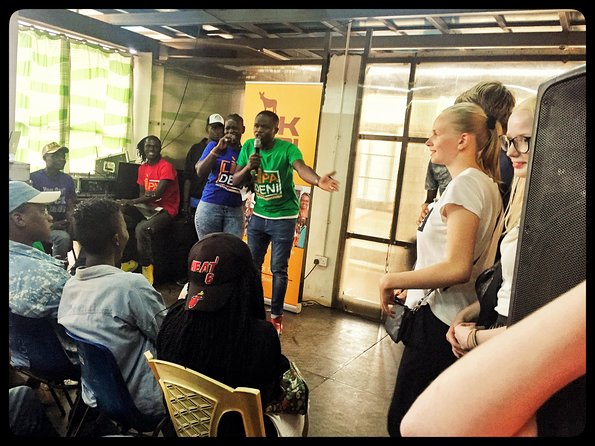
The guide matters greatly on a visit like this. A local guide can explain customs, transport, work, housing, and community life in ways that an outside observer cannot. The guide associated with this experience is named Luca, also written as Lucas in one account, and is described as being from Kibera.
That local connection is one of the strongest reasons to choose this tour. You are not left to interpret the setting on your own. Your guide can provide context, introduce you to people, and help keep interactions polite and appropriate.
The experience is also framed as a cross-cultural exchange. That means you should bring curiosity in both directions. You may ask about everyday routines, difficulties, and local projects, but you should also be ready to talk about your own country and life. One exchange included discussion about Brazil, showing that the conversation is not meant to be one-sided.
I would begin by asking your guide how the visit supports the people you meet. You can also ask before taking photographs. A friendly interaction does not automatically mean someone wants a camera pointed at them, especially in a private home or workplace.
From Ngong Road to Kibera by local transport
Pickup and drop-off are available from any hotel or commercial address along Ngong Road. That is useful if you are staying in the right part of Nairobi, since it removes some of the effort of arranging your way to the meeting point.
The tour itself lasts roughly three to four hours. One detailed account describes the guide collecting the group and going to Kibera by matatu, Nairobi’s shared minibus system. Along the way, the guide explained how public transport works and introduced the group to matatu culture.
This is a worthwhile addition because transport is part of city life, not just a way to reach an attraction. Still, do not assume that every booking includes a matatu ride. Confirm the meeting arrangement and transport plan when you book.
If your hotel is outside the Ngong Road pickup area, you will need to clarify where the tour begins. The information provided confirms pickup along Ngong Road, but it does not promise collection from every Nairobi neighborhood.
Walking through homes, streets, and community projects

The main stop is Kibera itself. The route includes a walk through the settlement, meetings with people from different backgrounds, street art, local food, and community organizations.
The visit to a typical home can be especially revealing. It gives you a chance to speak with a family about habits, challenges, and daily life in a setting that is usually hidden from outsiders. This part requires tact. Keep your voice low, follow the guide’s lead, and remember that you are entering someone’s personal space.
You also visit organizations working to improve conditions in the area. The available information does not name each organization or explain every project, so you should ask your guide what each group does and how visitors can support it responsibly. The point is not only to see hardship. It is also to see local ideas, work, and problem-solving.
That balance is important. Kibera can be visually and emotionally intense for someone from a wealthier country. At the same time, the people you meet are not defined by poverty. The visit works best when you notice both the limits people face and the ways they create opportunity, community, and dignity.
Street art adds another layer. Rather than treating the area as a collection of problems, the art shows expression and local creativity in public spaces. It gives the walk a cultural dimension and can prompt useful questions about who creates it, what subjects appear, and how public art affects the neighborhood.
A few more trips worth weighing up
- Nairobi National Park Half-Day Tour; Free Wi-Fi connection
★ 5.0 · 878 reviews - Nairobi: National Park & Optional Elephants & Giraffe Center
★ 4.8 · 874 reviews - NAI NAMI: Nairobi Storytelling Tour with Street Children
★ 5.0 · 792 reviews - Nairobi National Park Half-Day Game Drive
★ 4.5 · 738 reviews
Learning to prepare and eat Kenyan food

Food is one of the most approachable parts of the experience. You receive a lesson in preparing traditional Kenyan food and have the chance to eat local dishes.
This is more than a snack stop. Cooking creates a natural setting for conversation. You can ask about ingredients, family habits, and how food fits into everyday life. You also get a practical connection to Kenyan culture that does not depend on memorizing facts.
The details of the dish and cooking method are not specified in advance, so do not book expecting a particular menu. If you have allergies or dietary restrictions, ask the provider before confirming. The supplied information says you learn to prepare and eat local food, but it does not list substitutions or special dietary arrangements.
I would treat the food lesson as a shared activity rather than a performance. Joining in politely, asking before handling anything, and showing interest in the process will make the exchange more comfortable for everyone.
The emotional side of a Kibera visit

You may find the surroundings shocking. One account describes the experience as particularly powerful because it showed real living conditions rather than a simplified picture of Nairobi. That reaction is understandable, but it is worth preparing yourself for it.
The right attitude is neither avoidance nor pity. You are there to learn from people who know the area and to see how residents manage ordinary life. Smile and conversation can coexist with serious hardship, but do not mistake a warm welcome for proof that difficult conditions are unimportant.
I recommend keeping your expectations grounded. This is not a polished cultural attraction. Streets may be uneven, the setting may feel crowded, and the visit may challenge your assumptions. The information provided says most people can participate, but it does not promise a smooth route or a quiet environment. If you have mobility concerns, ask the provider for current route details before booking.
Photography deserves special care. The tour includes people, homes, food preparation, and community work, yet permission should guide every photograph. A private tour gives you a better chance to ask directly and follow local advice.
Is $40.90 a fair price?

At $40.90 per person, the tour is reasonably priced if you value direct local contact and a private format. You are paying for roughly half a day with a guide, pickup and drop-off along Ngong Road, a food activity, and access to a route that would be difficult to understand on your own.
The value is strongest for a couple, family, or group of friends that wants to ask questions and keep the pace personal. Since the price is per person, a solo visitor pays the same listed rate as part of a private group, so the cost may feel higher when you are alone.
I would not judge the price by the number of sights. There is no long list of monuments here. The value comes from time, introductions, local explanation, and the chance to take part in ordinary activities. If you want a quick photo stop, this may not feel worthwhile. If you want a guided conversation about life, work, food, and community action, the price is easier to justify.
The tour is popular enough to be booked about 71 days ahead on average. That suggests you should reserve early if your Nairobi dates are fixed, especially if you need a particular pickup time or guide.
Who should choose this private Kibera experience?

I would recommend Tembea Kibera to you if you want:
- A personal conversation-led experience rather than a standard sightseeing route
- A private tour for your own group
- A guide with local ties
- A chance to learn about Kenyan food through preparation and tasting
- An honest look at community projects and daily life
- A meaningful addition to a Nairobi itinerary
It may not suit you if you want air-conditioned transport throughout, a tightly scripted attraction, or an easy route with little emotional weight. The tour asks you to be present and respectful.
Families may find the private format useful, since the guide can explain difficult subjects at a suitable level. Couples and solo visitors can also benefit from the smaller setting, though solo visitors should consider the per-person cost.
Booking, weather, and cancellation details
You receive confirmation when you book, and the experience is available Monday through Sunday between 7:00 AM and 6:00 PM. It is near public transportation, and most people can take part.
The tour requires good weather. If poor weather causes cancellation, you are offered another date or a full refund. You can cancel for a full refund up to 24 hours before the start time. Cancellations or changes made within 24 hours are not refunded or accepted.
Before booking, confirm three practical points: the exact pickup address, whether matatu transport is part of your plan, and any food or mobility concerns. These questions take little time and can prevent confusion on the day.
Should you book Tembea Kibera?
Book this tour if you want to meet people, listen carefully, and understand Nairobi beyond its main sights. Its strongest features are the private format, the local guide connection, the home and organization visits, the food lesson, and the chance for genuine conversation.
The experience is not designed to make Kibera look comfortable or simple. It may challenge you, and that is part of its value. Go with humility, ask before taking photographs, and allow time for conversation instead of rushing from stop to stop.
At $40.90, it offers good value for a three to four-hour private visit, especially when pickup along Ngong Road is useful to you. I would choose it for an engaged, respectful cultural experience, but not for a casual sightseeing stop.
FAQ
How long does the Tembea Kibera tour last?
The tour lasts approximately three to four hours.
How much does the experience cost?
The listed price is $40.90 per person.
Is hotel pickup available?
Yes. Pickup and drop-off are offered from hotels and commercial addresses along Ngong Road.
Is this a private tour?
Yes. Only your group takes part in the activity.
Does the tour include local food?
Yes. You learn how to prepare traditional Kenyan food and have the opportunity to eat local food.
Can I cancel for a full refund?
Yes. You must cancel at least 24 hours before the experience start time to receive a full refund.
What happens if bad weather cancels the tour?
You are offered a different date or a full refund if the experience is canceled because of poor weather.
Is the tour available every day?
Yes. The stated operating hours are Monday through Sunday, from 7:00 AM to 6:00 PM.
Just added around Nairobi
- Nairobi: Giraffe Center, Elephant Orphanage and Bomas Tour★ 5.0 · 3 reviews
- Nairobi: Airport and Hotel Private Transfers.★ 4.0 · 3 reviews
- 11-Days Best of Kenya & Tanzania Big 5 Safari on a 4×4 Jeep★ 5.0 · 3 reviews
- Kitengela Anselm Hot Glass tour★ 4.5 · 3 reviews
- NAIROBI NATIONAL PARK AFTERNOON GAME DRIVE.★ 5.0 · 3 reviews
- 12-Day Tsavo west Amboseli lake Nakuru Maasai Mara safari★ 5.0 · 3 reviews
- Nairobi Down Town & Walking City Tour★ 4.8 · 3 reviews
- Carnivore Resturant Dinner Experience★ 4.0 · 3 reviews
Kibera Community Tours, compared.





Kibera Slum Tour with Local Social Entrepreneurs
Read our review →


Browse the lists this tour appears in